Cloud migration
Take your company to the next level, making it more competitive and efficient in an increasingly digitalized business environment. Start by moving applications, data, and systems from an on-premises infrastructure or another cloud provider to the Amazon Web Services (AWS) platform.

Start your cloud journey and discover the business benefits
Benefits of migrating to the cloud

Scalability:
Increase or decrease your resources as needed. This provides flexibility to adapt to changes in business demand without worrying about infrastructure capacity.

Cost savings:
Use a pay-as-you-go model. This reduces costs associated with purchasing and maintaining hardware, as well as operational expenses related to managing infrastructure.

Agility and speed:
Develop, deploy, and scale applications quickly and efficiently. Accelerating time to market and responsiveness to market demands.

Availability and redundancy:
AWS has a global infrastructure with multiple data centers and regions, ensuring high availability and redundancy for business applications and data. This reduces the risk of unplanned downtime.

Security:
Advanced security measures, including data encryption, access control, security monitoring, and compliance with standards and regulations. This helps protect business data and infrastructure against cyber threats.

Innovation:
AWS continues to release new services and features to improve business efficiency and innovation capabilities. This allows companies to take advantage of the latest technologies without having to worry about managing the underlying infrastructure.
Cloud migration offers companies the agility, scalability, and security needed to compete and thrive in an increasingly digital business world.
Make the change today and take your company to the next level!
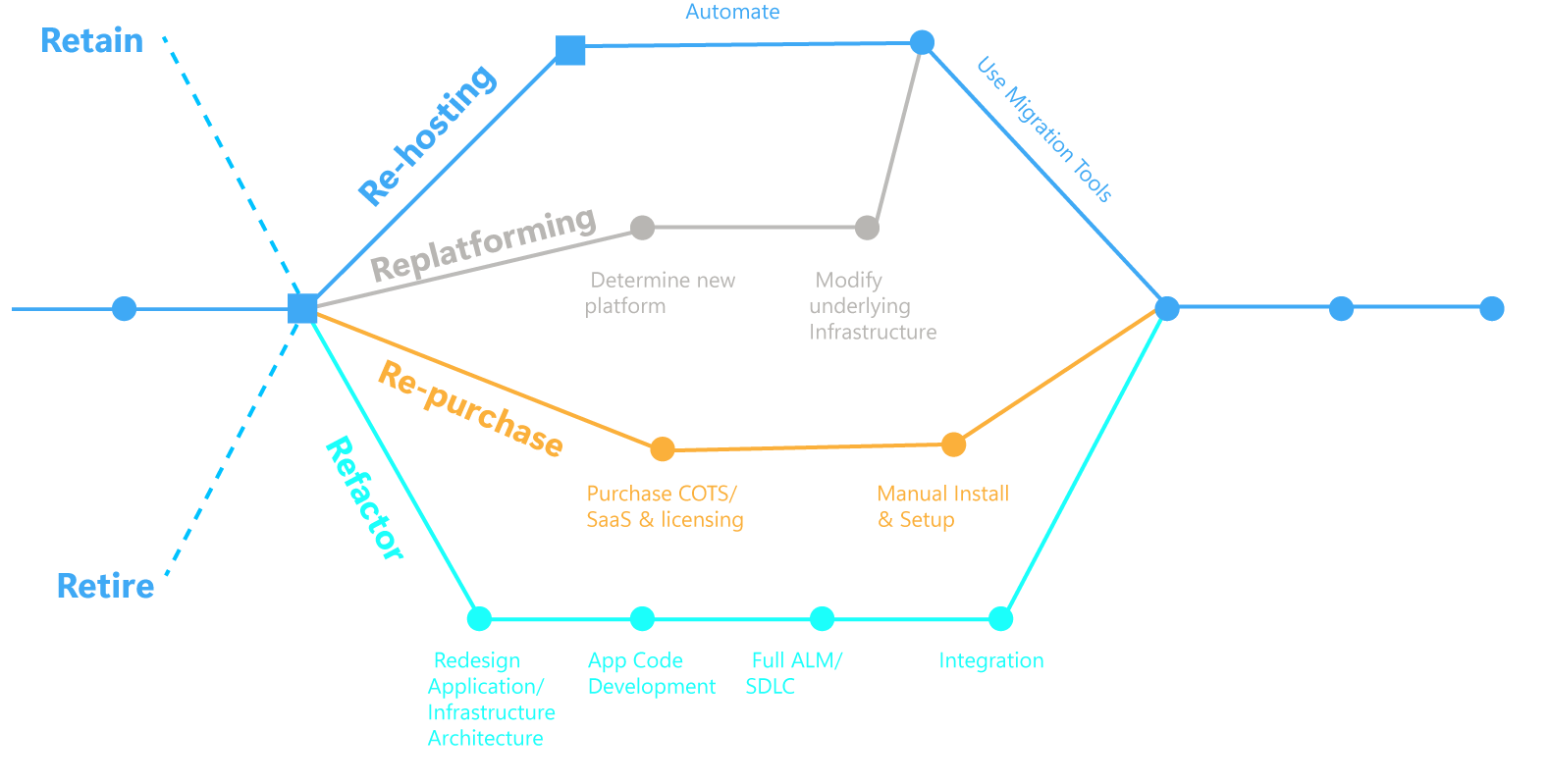
Know the different ways to migrate to the AWS cloud
Before starting any migration, it is important to have a cloud consultancy by an expert, so that he recommends the one that best suits the needs of your company

-
Re-hosting (Or Lift and Shift):
It consists of moving existing applications to the AWS cloud without making significant changes to the code. It is more about replicating the infrastructure and configuration in the AWS cloud.
-
Replatforming (Or Lift, Tinker, and Shift):
In this type of migration, some adjustments are made to the architecture of the applications to better take advantage of the capabilities of the AWS cloud. This may include database optimization, implementation of AWS managed services, etc.
-
Refactor (Or Re-architectonic):
At this level, part or all of the application is rewritten or redesigned to take full advantage of the native services of the AWS cloud. This may involve profound changes in code and architecture to achieve greater scalability, availability, and performance.
-
Retire:
It refers to the elimination of systems, applications, or data that are no longer needed after migrating to the AWS cloud.
-
Re-purchase:
Some companies choose to stop maintaining their applications internally and instead use SaaS (Software as a Service) services available on AWS. This involves migrating to third-party applications that are already hosted in the cloud.
-
Retain:
In this case, the application is kept as it is, as there is no system that fits the company's needs. In this way, it is preferable to maintain the existing system.

Don't fall behind in the digital revolution. Migrating to the cloud is the first step towards innovation and competitiveness
Know our
Success stories